
Coconut charcoal briquettes go through eight distinct production stages before they reach a sealed shipping container. Each stage affects the quality of the final product in ways that are measurable at the laboratory level and visible to end users within weeks of use. This article walks through each stage as it runs on our Java production network, so buyers and distributors understand exactly what they are sourcing.
Stage 1: Raw Material Selection
The base material for all our shisha and BBQ grades is coconut shell, specifically the hard endocarp layer of mature coconuts harvested from copra and desiccated coconut processors across Java. Shell from mature coconuts carries higher fixed carbon content than shell from younger fruit, and significantly higher fixed carbon than coconut husk (the outer fibrous layer). This distinction matters at every downstream stage. Before entering our carbonization lines, incoming shell is inspected for moisture content and uniformity. High-moisture shell requires longer carbonization cycles and produces less consistent calorific output. Shell lots that do not clear our incoming inspection threshold are rejected before carbonization begins.
For our Premium BBQ grade, where the end use case supports a different raw material profile, the composition is disclosed on the spec sheet before the order is confirmed. Buyers know what is in the briquette before they sign the purchase order.
Stage 2: Carbonization
Carbonization is the thermal conversion of raw coconut shell into charcoal through controlled pyrolysis. Shell is loaded into kilns and heated to 600 to 800 degrees Celsius in a low-oxygen environment. The heat drives off moisture, volatile organic compounds, and non-carbon material, leaving behind a high-fixed-carbon char. The carbonization profile, specifically the peak temperature, hold time, and cooling rate, determines the final calorific value and ash content of the char. A longer, hotter cycle drives volatile matter lower and produces denser char with better burn characteristics. A shorter cycle saves fuel and time but leaves more volatile matter in the char, which shows up as sparking and off-notes in the final briquette.
Our Super Premium and Premium Shisha grades run a longer carbonization cycle calibrated for low volatile matter and calorific values above 7,200 kcal/kg. Medium and BBQ grades run a profile appropriate to their target spec range.
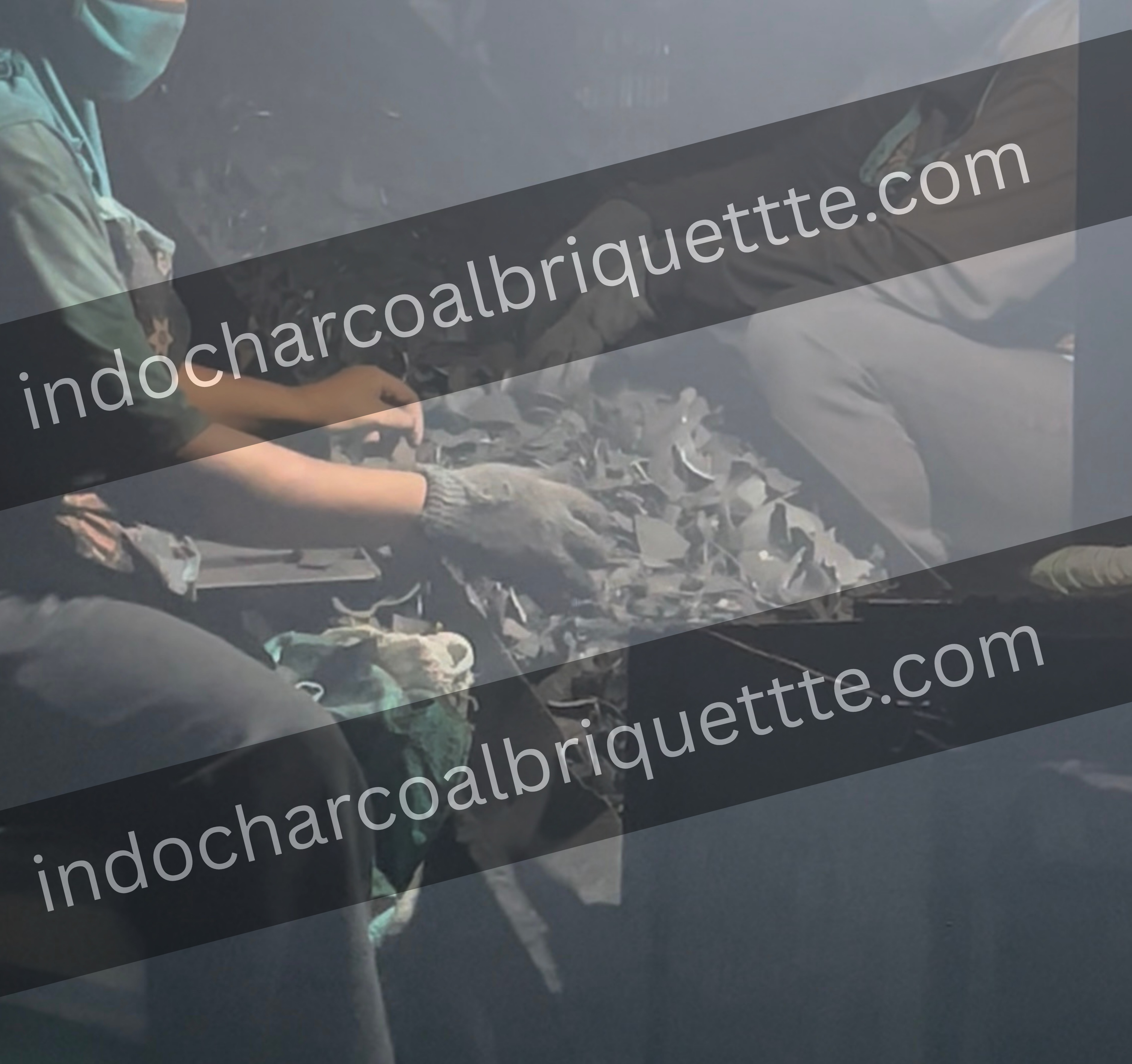
Stage 3: Grinding
After carbonization and cooling, the char is fed through grinding mills to produce a fine, uniform powder. Particle size consistency at this stage directly affects briquette density and structural integrity. Coarse or inconsistent grind produces briquettes that crack during drying or crumble during handling, generating fines that customers reject.
The grinding line runs continuous particle-size checks. Powder that does not meet the target distribution is sent back through the mill before it moves to mixing.
Stage 4: Mixing and Binding
Ground char is blended with a natural binder at controlled ratios. We use tapioca starch as the binding agent across all grades. Tapioca is a food-grade, combustion-safe binder that holds briquette shape through pressing and drying without introducing chemical residues into the burn profile. This is a critical specification for shisha grades, where flavor neutrality depends on clean combustion.
Binder ratio is calibrated per grade. Higher binder content improves briquette hardness but can slightly reduce calorific output. The ratio for each grade is fixed and verified in production records.
Stage 5: Pressing and Shaping
The mixed char-binder material is fed into hydraulic press machines, where it is formed into briquettes under high pressure. The press die determines the shape and size of the output.
Our standard shape range includes hexa, cube, hexa flower, and rectangle (key). All shapes are available across grades. Sizes are customizable to buyer specifications, and custom shapes are available for private label production runs. The press pressure target for each grade is set to achieve the density specification before the briquette enters the drying line.
Stage 6: Drying
Freshly pressed briquettes carry significant moisture from the water-based binder mix. Drying reduces that moisture to the grade target (under 5 percent for Super Premium, under 6 percent for Premium and Medium grades, under 8 percent for BBQ) before packaging. Drying is done in tunnel or oven dryers at controlled temperature. Under-dried briquettes develop mold in packaging and produce excess steam when lit, which customers interpret as poor quality. Over-dried briquettes become brittle and generate fines during handling and shipping. Moisture content is tested on every production batch before briquettes move to the QC inspection stage.
Stage 7: Quality Control and Laboratory Testing
Every production lot is tested against four core parameters before it is cleared for packaging and export: calorific value (kcal/kg), ash content (percent by weight), moisture content (percent by weight), and volatile matter (percent by weight). Testing is conducted in-house on every lot, with third-party laboratory certification available on request. Buyers receive the analysis certificate for their specific lot before the container is sealed. If a lot does not meet the grade specification, it is held for investigation and does not ship as the declared grade. Visual inspection runs alongside lab testing. Briquettes are checked for surface cracks, dimensional consistency, and color uniformity. Lots with excessive fines or shape defects are pulled from the export line.
Stage 8: Packaging
Cleared briquettes are packed into inner bags, then master cartons or bulk sacks depending on buyer specification. Inner packaging options include 0.5 kg, 1 kg, and 2.5 kg retail bags for shisha grades, and loose-fill or bulk-bag formats for BBQ grades. Master carton counts and pallet configurations are set to the buyer's requirements for their destination market.
Private label packaging is available for all grades. Buyers supply artwork to our dieline specification, and we produce to the agreed label layout before container loading. Production lead time accounts for packaging material procurement when custom artwork is involved.
Stage 9: Container Loading and Export Documentation
Finished, packaged briquettes are palletized and loaded into 20-foot or 40-foot containers. Container loading follows a pallet plan designed to maximize load stability and minimize briquette damage in transit. Each container is sealed after a final count check against the packing list.
Export documentation produced at this stage includes the commercial invoice, packing list, certificate of origin, and phytosanitary certificate where required by the destination country. Lab analysis certificates for the shipped lot are attached to the document package. Buyers receive a complete document set before or alongside the bill of lading, depending on the agreed payment and shipment terms.
What This Means for Buyers
The eight-stage sequence above is not unique to premium production. What varies between suppliers is where shortcuts are taken and whether those shortcuts are disclosed. The most common points of quality divergence in the coconut charcoal supply chain are raw material selection (shell versus husk or blend), carbonization cycle length (shorter cycles leave more volatile matter), binder type (some factories use chemical binders not suitable for food-adjacent use), and QC discipline (lot-level testing versus periodic or absent testing).
When you request a quotation or sample from us, you receive the lab analysis for the specific lot or production run, not a generic certificate. The grade, raw material, and production parameters are documented before the order is placed.
Request a Sample or Quotation
If you are evaluating coconut charcoal briquette suppliers and want to verify the production standards described above against a physical sample, request a quotation through our quotation form. Our team will confirm grade availability, lead time, and shipping options for your destination.
Terms and conditions apply: sample shipments require the buyer to cover the product cost, independent lab testing cost, international courier shipping, and any applicable duties or destination handling charges. Our team will quote these costs together with the production lead time and shipping options once we understand your destination and target grade.


